| Chapter 5: Saloons & Stages - Life after Baseball |
| After 22 seasons playing and managing for Chicago, Cap Anson found his ties to the organization cut in the spring of 1898. Personally, he felt betrayed by his old friend, Al Spalding. Anson had tried to raise money to purchase a majority share of the team, but his efforts fell short in part because the Spanish-American War had financiers' money supplies in low supply. Cap did not retire a rich man, as would the ball player of today. He had signed a multi-year contract with Chicago in 1889 that called for him to earn part of his salary as profit sharing from the team's revenues. Yet Spalding had invested the team's profits in building the new West Side Stadium, and therefore declared no real profits, leaving Anson without compensation. When Spalding attempted to raise money for Anson by organizing a retirement dinner with celebrity and athlete invitees, Anson refused to take part. He rebuked Spalding's attempt at reparations, saying "The public owes me nothing and I am neither old nor a pauper. I can earn my own living as hitherto, and, moreover, I am by no means out of baseball."
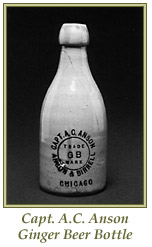
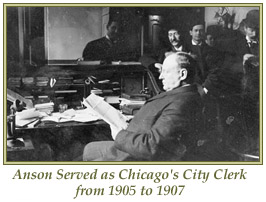
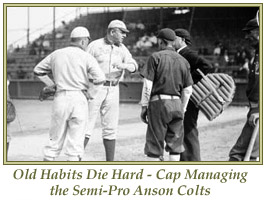
With baseball behind him, Anson tried his hand as an entrepreneur. The results were mostly disastrous. He first went into a business partnership bottling ginger beer. According to Anson, a flaw in the ginger beer's recipe caused the bottle caps to explode off the bottles as they lay in storage. His investment ended up on the floor of a partner's basement. He then approached John Wanamaker with a scheme to manufacture baseballs in direct competition to Al Though a failure in business, Anson remained popular with the citizens of Chicago. In 1905, the city elected Anson, running on the Democratic ticket, as its City Clerk. Anson's fiery temper on the playing field was in stark contrast to his laid back political style, and he served just one term due in part to his unhurried demeanor. During this same period, Anson attempted to once again grace the baseball diamond. He bought a semi-pro baseball team and acted as its manager. The team was named Anson's Colts and played in Chicago. Many of the players were university students attending DePaul University and the University of Illinois- Anson, a fan of vaudeville, began a new career on the stage. He performed short vaudeville monologues and comedic routines, sometimes accompanied by his two daughters. One of his plays was entitled "The Runaway Colt" and featured Cap in the role of a heroic batsman that hit a game-winning home run. Anson would hit the ball, dash off the stage's right side, run around the stage curtain to emerge from the left side of the stage and slide into home base. A catcher would receive the throw home, but Anson would beat the tag. Anson traveled the Orpheum circuit, performing in small theaters in New England and the Midwest. Crowds cheered his performances, but chances are most of the applause was in recognition of his celebrity as an athlete, not as an actor.
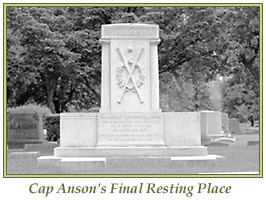
Adrian "Cap" Anson was buried in Chicago's Oakwood Cemetery, where he lays in eternal rest next to his beloved wife Virginia. At the time of his funeral, only a small headstone was placed that read "Adrian Constantine Anson 1852-1922." Several of his old friends from the National League raised funds to add a more fitting monument in 1923. Its towering column with carved laurel wreath and crossed baseball bats befits Cap's larger than life persona. Even today, the gravesite continues to attracts visitors, a testament to Cap's enduring legacy to both baseball and the city of Chicago. The dedication on it reads: Capt. Adrian Constantine Anson HE PLAYED THE GAME Erected to his Memory by the National League |
 Anson did indeed try to return to baseball, but the result was short-lived. He accepted a contract to manage the New York Giants from team owner Andrew Freedman. Anson wanted control of the team, but Freedman, a man known as a meddler, was unable to relinquish control. Cap left the team within three weeks of his arrival and returned to Chicago. He failed in an attempt to purchase a team in the Western League (soon to become the American League) when Spalding intervened with league owners to block the purchase. Despite the bravado of his "I am by no means out of baseball" claim, Cap's active role in the National League had come to end.
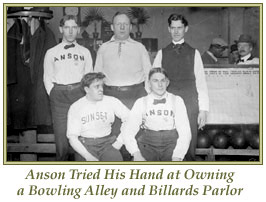 Spalding's athletic goods empire. Wanamaker, knowing Spalding's clout, wisely decided against the idea. Next, Anson opened a bowling alley and billiards parlor. Anson was known as an expert billiards player, having taken up the game in his youth in Marshalltown and playing all his life. However, his skills with a pencil were not as great as with a pool cue - poor management caused the downfall of the club.
 Chicago. Anson's Colts lasted only a few seasons before being dissolved due to lack of attendance.
 Anson's acting career continued into 1921. At the age of 69, Anson was still going strong. He enjoyed golfing and taking walks in his spare time. So it came as a surprise when he was stricken with a glandular ailment the following year, and passed away suddenly on April 14, 1922, three days before his 70th birthday. News of his death traveled quickly throughout the city of Chicago. A grand funeral was planned, and thousands of mourners, including many ball players and executives, paid their respects as Anson's coffin was paraded through the city streets. It was a fitting sendoff for baseball's first superstar and Chicago legend.