| The Captain's Mates - A List of Cap Anson's Teammates | |
| Cap Anson shared the diamond with more than 270 different men throughout his illustrious career. Five of the men listed here are enshrined with Anson in the Baseball Hall of Fame. Countless others will be recognizable to fans of 19th century baseball. Some are all-but-forgotten names that played only the proverbial "cup of coffee" in the big leagues. Presented here is a comprehensive list of Cap's teammates through the years. | |
| 1871 Rockford Forest Citys 1872 Philadelphia Athletics 1873 Philadelphia Athletics 1874 Philadelphia Athletics 1875 Philadelphia Athletics 1877 Chicago White Stockings 1878 Chicago White Stockings 1879 Chicago White Stockings 1880 Chicago White Stockings 1881 Chicago White Stockings 1882 Chicago White Stockings 1883 Chicago White Stockings 1884 Chicago White Stockings 1885 Chicago White Stockings 1886 Chicago White Stockings 1887 Chicago White Stockings 1888 Chicago White Stockings 1889 Chicago White Stockings 1890 Chicago Colts 1891 Chicago Colts 1892 Chicago Colts 1893 Chicago Colts 1894 Chicago Colts 1895 Chicago Colts 1896 Chicago Colts 1897 Chicago Colts | Hall of Fame Teammates John Clarkson
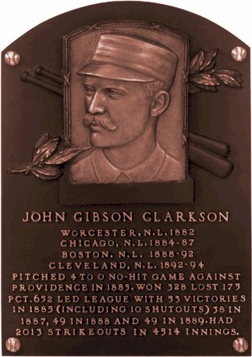
Though he played just 12 major league seasons, John Clarkson was a standout among 19th century pitchers. His wide variety of curve balls and his outstanding ability to pitch to the batter's weakness propelled him to a lofty 327-177 career record. He won 53 games in leading the Chicago White Stockings to the 1885 National League pennant and twice hurled over 600 innings in a season. At the time Clarkson retired from the game, he was the winningest pitcher in National League history. Hugh Duffy
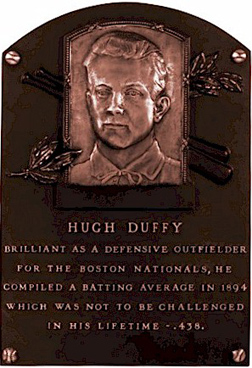
A brilliant defensive outfielder for the Boston Beaneaters, Hugh Duffy also hit the ball with authority, showing remarkable power for his diminutive stature. He assembled a string of ten straight .300-plus seasons, and in 1894 he batted .438 while leading the National League in doubles (50) and home runs (18). Duffy's stellar all-around play helped Boston to four pennants during his nine-year tenure with the club. Clark Griffith
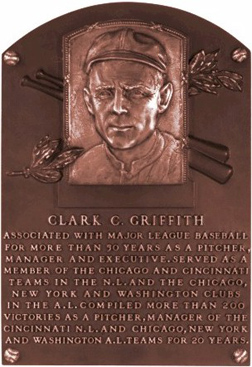
Known as "The Old Fox," Clark Griffith was an imaginative player, manager and owner. As a pitcher, he topped the 20-victory mark six years in a row for the White Stockings, amassing 237 career victories. In 1901, as a player-manager, he led Chicago to the first American League pennant. An innovative owner, Griffith worked within a limited budget, signing many Latino players, reworking the waiver rules, courting publicity, and keeping the Senators franchise afloat from his arrival in Washington in 1912 to his death in 1955. Mike "King" Kelly
Not only was Mike "King" Kelly one of the premier players of his day, he was also one of the most flamboyant. His daring baserunning prompted fans to coin the battle cry, "Slide, Kelly, Slide," and the catcher-outfielder sparked the Chicago Nationals to five pennants. Manager Cap Anson credited Kelly with originating the hit-and-run play. After capturing the batting crown in 1886, the colorful Kelly was sold to the Boston Beaneaters for a then-record $10,000. Albert Spalding
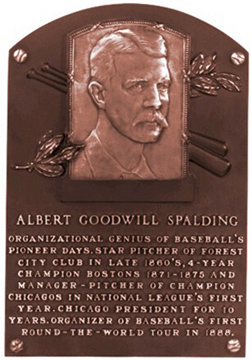
A.G. Spalding was the premier pitcher of the 1870s and an organizational genius during baseball's formative years. He led the league in pitching victories in each of his six full seasons in Organized baseball (1871 to 1876). His 47 victories led the '76 Chicago White Stockings to the first-ever National League championship. With the success of the sporting goods business he founded in 1876, Spalding left the playing field for an executive role with the White Stockings; as team president from 1882 to 1891, he directed the club to three pennants. |
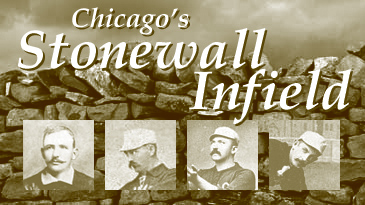
| Chicago's Stonewall Infield
Cap Anson, First Base
"This was the infield that became famous as 'Chicago's stone wall,' that name being given to it for the reasons that the only way a ball could be gotten through it was to bat it so high that it was out of reach. The members of that famous infield were Williamson, Pfeffer, Burns and myself, and so long had we played together and so steadily had we practiced that there was scarcely a play made that we were not in readiness to meet. We had a system of signals that was almost perfect, and the moment that a ball was hit and we had noted its direction we knew just what to look for. We were up to all the tricks of the game, and better than all else we had the greatest confidence in each other." Fred Pfeffer, Second Base
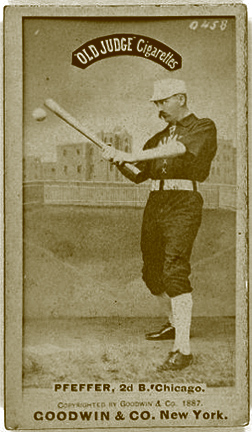
"Fred Pfeffer, who came from Louisville, Ky., was a ball-player from the ground up, and as good a second baseman as there was in the profession, the only thing that I ever found to criticize in his play being a tendency to pose for the benefit of the occupants of the grand stand. He was a brilliant player, however, and as good a man in his position according to my estimate as any that ever held down the second bag. He was a high-salaried player and one that earned every cent that he received, being a hard worker and always to be relied upon." Ned (Ed) Williamson - Shortstop
"Ed was, in my opinion, the greatest all-around ball-player the country ever saw. He was better than an average batsman and one of the few that knew how to wait for a ball and get the one that he wanted before striking. ... At short Williamson was right in his element and in spite of his size he could cover as much ground in that position as any man I have ever seen. While his throwing was of the rifle-shot order, it was yet easy to catch, as it seemed to come light to your hands, and this was also true of the balls thrown by Pfeffer and Burns, both of whom were very accurate in that line." Tom Burns - Third Base
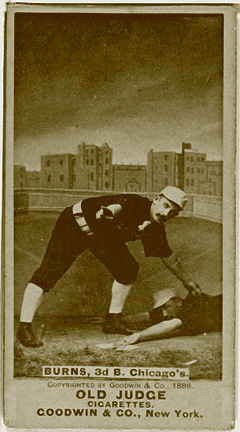
"At third base Burns was as good as the best of them, he excelling at the blocking game, which he carried on in a style that was particularly his own and which was calculated to make a base-runner considerable trouble. ... He was a fair base-runner, using excellent judgment in that respect, and a first-class slider, going into the bases head first when compelled to make a slide for them, instead of feet first, like the majority of the players of that day and generation; in fact, he was more of a diver than a slider, and he generally managed to get there." | |